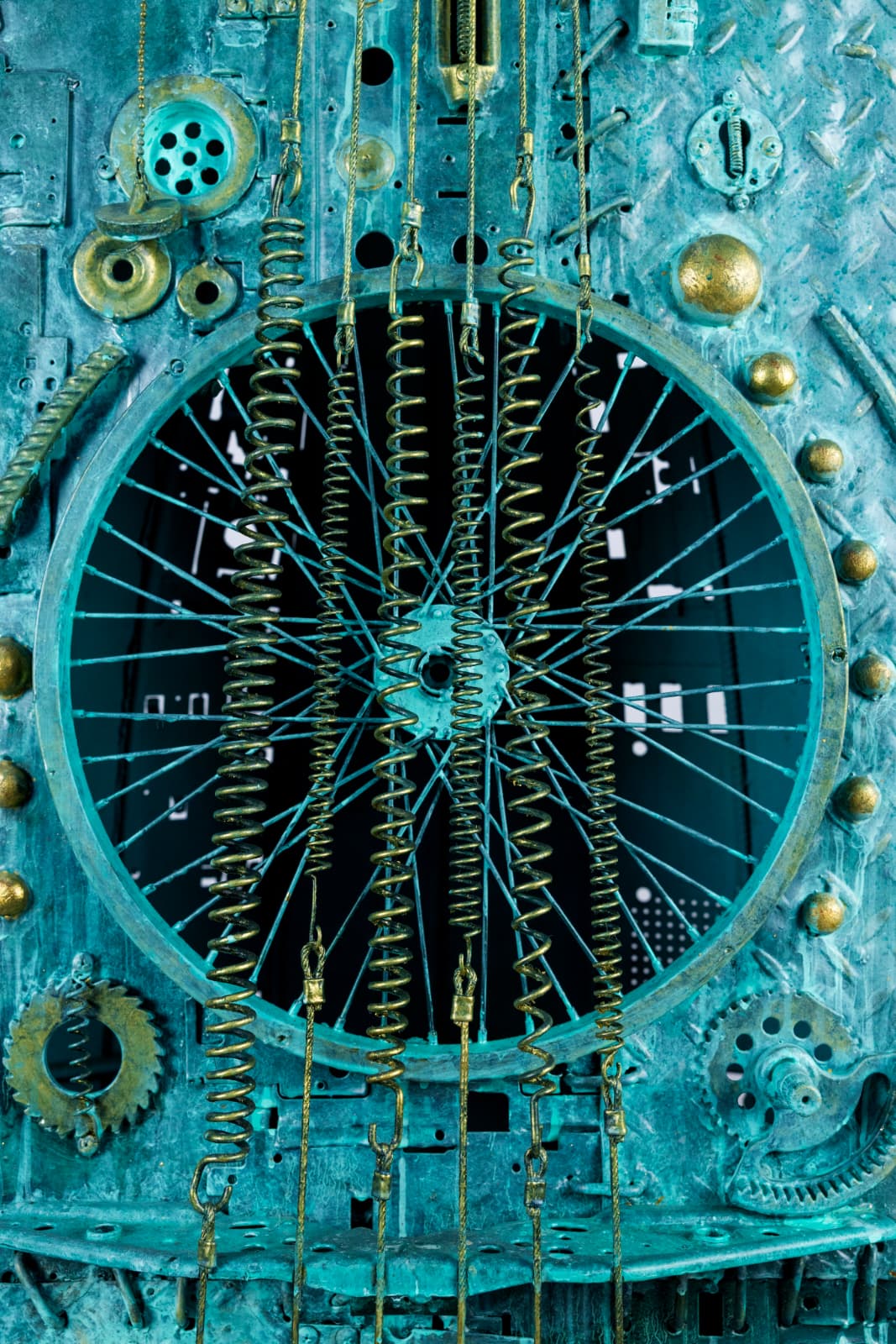
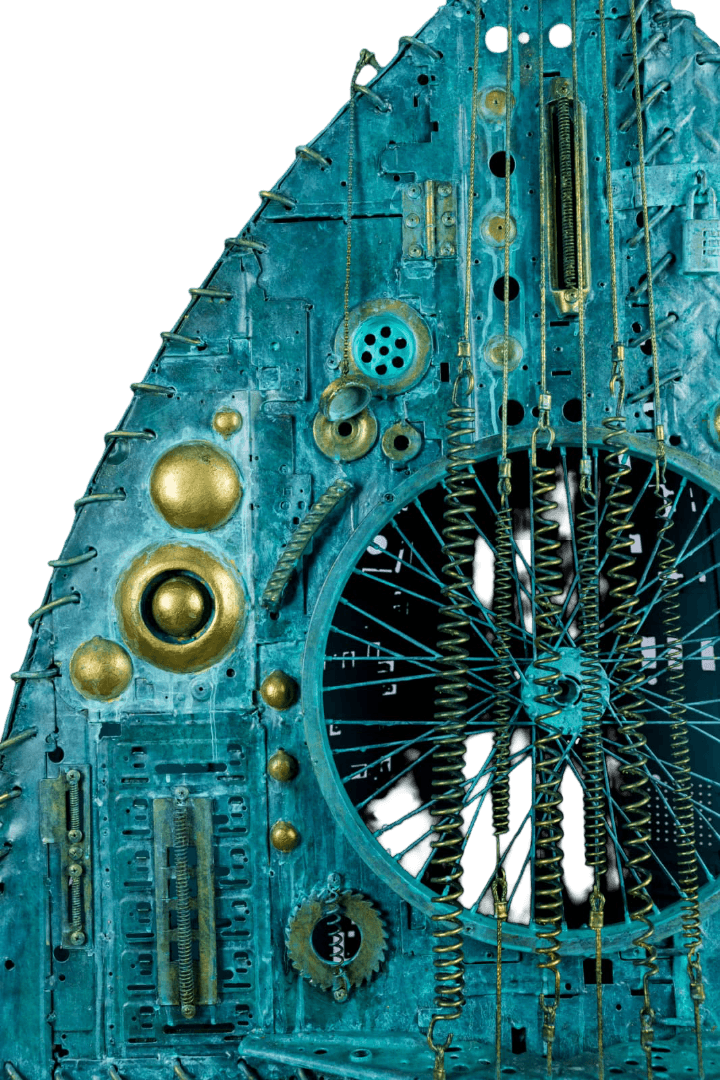
At the heart of the artwork stands a bicycle wheel. Once, its purpose was to turn and carry someone from one place to another. Here, its movement has ceased, yet it has become the centre of a musical instrument.
A circle has no obvious beginning or end. It becomes a symbol of life’s cycles: we begin, we move, we stop, and then we begin again in another form.
The wheel itself has lived this transformation. It no longer carries a person towards a new destination; it now carries an idea into a new era.
The Spring — Pressure
A spring fulfils its purpose only when subjected to pressure. It compresses, expands, and returns — much like a human being.
Pressure is not always an ending. Sometimes it is the force that reveals the resilience within us.
Here, the lock, key, and spring meet in one idea. We may possess the key and know which door it opens, yet only when life puts us under pressure do we discover that we are capable of opening it.
What We Hold, What We Release
The bathtub drain and its stopper, connected by a chain — ordinary objects once used to control the flow of water.
Their original purpose was simple: to hold water in place or allow it to drain away.
Yet within this artwork, they become a reflection of something deeply human.
Throughout our lives, we constantly decide what to hold on to and what to release.
We hold on to memories, relationships, promises, and emotions, sometimes long after they have served their purpose.
Like water, life is meant to flow. And when we try to hold everything in place, even the things that once brought us comfort can begin to weigh us down.
The stopper represents our desire to preserve what matters. The drain reminds us that not everything is meant to remain. And the chain becomes a symbol of the connection between holding on and letting go.
Sometimes, what we release is just as important as what we choose to keep.
Because wisdom is not found in holding on forever, nor in letting everything disappear.
It is found in knowing when to do each.